

Blue, purple, gold, green niobium jewellery can produce some remarkably vivid colours.
But here's the interesting bit.
The colour isn't paint. It isn't enamel. And it isn't conventional coloured plating.
Niobium is a metal that can be anodised to create different colours by changing the transparent oxide layer on its surface. That changes the way light interacts with the metal, producing colour without simply coating it in blue, purple or gold pigment.
It's one of the reasons niobium is such an interesting material for contemporary jewellery and why Australian jewellers can use it to create colourful pieces that look very different from conventional gold and silver jewellery.
What is niobium?
Niobium is a metallic element. In its natural state it isn't bright purple, electric blue or gold.
Those colours are created through a process called anodising.
Anodising changes the thickness of the transparent oxide layer on the surface of the niobium. Different thicknesses affect the way light reflects from the surface, allowing the jeweller to produce different visible colours.
So rather than covering the metal with coloured paint, the jeweller is using the surface of the metal itself and light to create the effect.
That's considerably more interesting than just painting it blue.
Why does niobium jewellery have so many different colours?
It comes down to light.
By controlling the anodising process, a jeweller can alter the oxide layer on the niobium and produce colours including blue, purple, gold and green tones.
The resulting colour can also appear slightly different depending on the light and the angle from which you're looking at it.
That's part of the appeal.
Niobium isn't trying to imitate a blue gemstone or pretend to be yellow gold. It has its own way of producing colour.
Is coloured niobium painted?
No.
This is probably the single most useful thing to understand about colourful niobium jewellery.
The colour isn't a layer of blue or purple paint sitting on top of the metal.
Nor is it conventional enamel.
Instead, anodising changes the transparent oxide layer on the surface. Light interacting with that layer creates the colour you see.
That makes niobium particularly interesting for someone who likes colourful jewellery but wants the colour to come from the material and the jeweller's technique rather than an applied pigment.
What does blue niobium look like in jewellery?
Pretty striking.
The Blue Niobium & Fine Silver Men's Cufflinks by Australian jeweller Philip Monk are a good example.
The design combines anodised blue niobium with fine silver, allowing the intense colour of the niobium to sit against the cooler silver.
They're colourful without relying on a novelty motif, which makes them an interesting alternative to conventional silver or enamel cufflinks.
Put them with a French cuff shirt and the colour does the work.
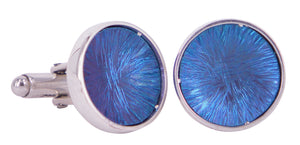
Blue Niobium & Fine Silver Men's Cufflinks by Philip Monk
Can niobium be colours other than blue?
Absolutely.
That's one of the reasons the material is so much fun.
Different anodised finishes can produce purple, blue, green and gold tones, among others.
The Purple Niobium & Argentium Silver Men's Cufflinks show just how dramatically the same metal can change character when a different colour is created.

Purple Niobium & Argentium Silver Men's Cufflinks by Philip Monk
The same material also appears in earrings and lapel pins, where even a relatively small amount of vivid colour can completely change the personality of the piece.
Is every piece of niobium jewellery exactly the same colour?
Not necessarily particularly when you're looking at individually finished handmade jewellery.
Slight variations in the anodised colour can occur from piece to piece.
Rather than treating that as a defect, it's worth remembering what you're buying.
This isn't a factory trying to make ten thousand pieces look absolutely identical.
When an Australian jeweller individually makes and finishes a piece, small variations are part of the process.
For someone who specifically wants handmade jewellery rather than mass-produced accessories, that's arguably part of the point.
Is niobium lightweight?
Yes. Niobium is relatively lightweight, which makes it particularly useful for jewellery such as earrings, cufflinks and lapel pins.
That's important because colourful jewellery doesn't necessarily need to be physically heavy to have visual impact.
A small niobium earring can introduce a flash of purple or gold without becoming a large statement piece.
A pair of cufflinks can provide vivid colour at the wrist without the weight you might associate with a much heavier piece of jewellery.
Why combine niobium with silver?
Contrast.
Bright silver provides a neutral background against which anodised niobium can really stand out.
Philip Monk uses this particularly effectively in his niobium cufflinks, combining colourful niobium with silver rather than trying to make the entire piece one colour.
The Blue Niobium & Fine Silver Men's Cufflinks show how effective that contrast can be.
You notice the blue precisely because it isn't everywhere.
Is niobium only used for men's cufflinks?
Not at all.
Niobium works particularly well wherever a jeweller wants to introduce strong colour without relying on paint or enamel.
At Lord Coconut you'll find it used across cufflinks, earrings and lapel pins.
That also means you don't have to go big to wear it.
A colourful stud earring or lapel pin can be a relatively understated piece of jewellery in terms of size while still having an unusual flash of colour.
Does the colour on niobium wear off?
The anodised colour is created at the surface of the metal, so it should still be treated with some care.
Abrasive polishing can affect the surface, which is why you shouldn't attack colourful niobium jewellery with an aggressive polishing compound in an attempt to make it shinier.
Scratching can also affect the appearance of the surface.
Clean niobium jewellery gently with a soft cloth and store it separately from harder pieces that could scratch it.
And as with any handmade jewellery with an unusual finish, check the care information for the individual piece rather than assuming it should be cleaned exactly like polished sterling silver.
Why don't you see niobium jewellery everywhere?
Gold and silver have thousands of years of jewellery history behind them.
Niobium is considerably less familiar to most jewellery buyers.
And that's part of what makes it interesting.
If you want a conventional polished silver accessory, there are plenty of them around.
If you want a piece made by an Australian jeweller using an unusual metal to create vivid colour through the material itself, niobium gives you something rather different.
It's colourful without necessarily being flashy.
It's contemporary without looking mass-produced.
And you may find yourself having to explain what it is when somebody asks about it.
We don't think that's a bad thing.
So, what makes niobium jewellery special?
Niobium gives jewellers something that conventional precious metals don't easily provide: intense colour created through the surface of the metal itself.
Blue can be genuinely blue. Purple can be properly purple. Gold and green tones can appear without simply painting or enamelling the jewellery.
Combine that with the individuality of handmade jewellery and you get pieces that can be small and easy to wear while still being decidedly different.
If you've never heard of niobium before, you're probably not alone.
But once you've seen what a good jeweller can do with it, plain silver suddenly has a bit more competition.
Explore Lord Coconut's Australian-made men's cufflinks, earrings and lapel pins to discover colourful niobium jewellery handmade by independent Australian jewellers.
Frequently asked questions
What is niobium jewellery?
Niobium jewellery is jewellery made using the metal niobium. Jewellers can anodise its surface to create vivid colours including blue, purple, green and gold tones.
Why is niobium jewellery colourful?
The colour comes from light interacting with a transparent oxide layer on the surface of the niobium. Anodising changes the thickness of this layer, allowing different colours to appear.
Is coloured niobium painted?
No. Anodised niobium isn't coloured with conventional paint or enamel. The visible colour is produced through the surface oxide layer and the way light interacts with it.
Is niobium colour a plating?
No. Conventional coloured plating adds another material over the surface. Anodising instead changes the oxide layer on the niobium itself.
Does the colour of niobium jewellery wear off?
The colour is created at the surface, so scratching and aggressive polishing can affect its appearance. Niobium jewellery should be cleaned gently and abrasive polishing compounds should be avoided.
Is niobium jewellery lightweight?
Yes. Niobium is relatively lightweight, which makes it particularly useful for colourful earrings, cufflinks and lapel pins.
Will every handmade niobium piece be exactly the same colour?
Not necessarily. Slight variations can occur in individually anodised and handmade pieces, and the colour can also appear somewhat different depending on lighting and viewing angle.